Feb. 16, 2021
We see the bicycle as the means of transportation that fits perfectly within a physically and economically healthy city. The actual social costs and benefits of cycling are still not always included in investment choices. Together with Movares we calculated that a good flow of cyclists may save millions of Euros!
Robust bicycle structures
We want to develop solutions that make a strong contribution to a healthy, safe and livable environment. The bicycle plays an important role in this. We seek the solution in designing robust bicycle structures. This improves traffic flow, reduces waiting times and decreases the number of lost hours. Enough reasons to look into this further in order to gain more insight into the economic effects of the decrease in bicycle loss hours.
Fewer bicycle loss hours
Some valuation key figures are now known. For example, the travel time valuation of cyclists is estimated at approximately €9.00 per hour. Let's do theoretical arithmetic, then bicycle waiting times for a municipality could amount to millions annually. This is worth investigating, as such figures could undoubtedly free up budget to solve current bottlenecks. To date, the main focus in the Netherlands has been on reducing so-called VVUs, vehicle loss hours in car traffic. Why not pay more attention to bicycle loss hours (FVUs)?
Economic value
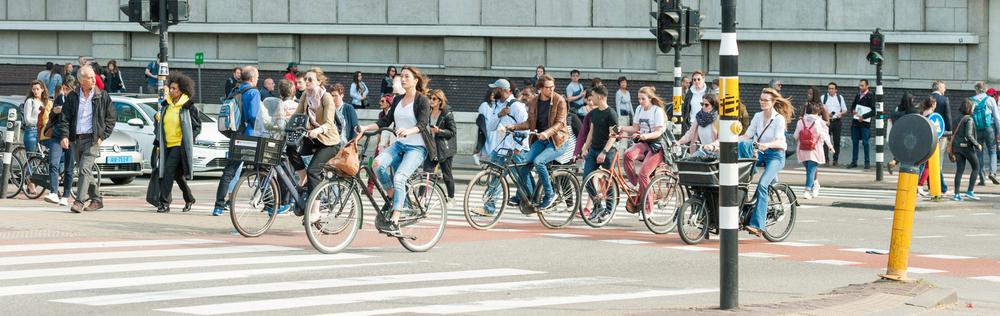
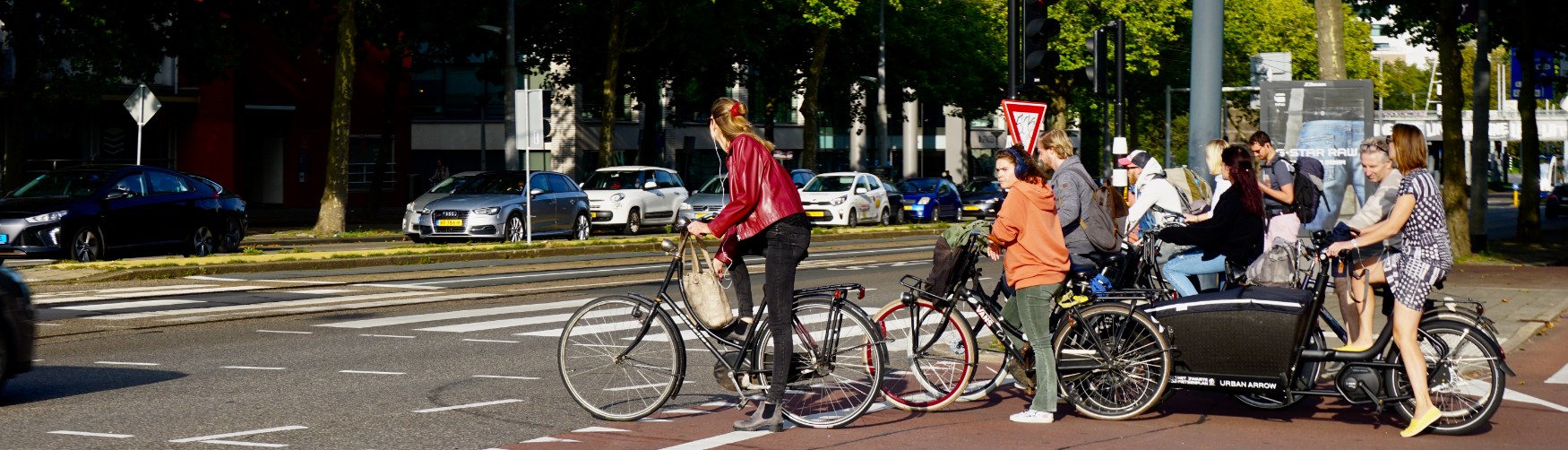
There are now innovations on the market that measure bicycle intensities and can link data directly to smart traffic lights. Together with Movares, we did a first exploration of the economic value, focusing for convenience on waiting times at intersections. This yielded the following calculations:
- A city like Deventer has 100,000 inhabitants. If we assume that an average cyclist encounters four or five iVRIs (intelligent Traffic Control Installation) every day per trip, this amounts to an annual economic travel time loss of about 10 million euros.
- We can also do this for an individual route, for example from Utrecht Central Station to Utrecht University (about 5 km). Here some 20,000 cyclists pass five iVRIs every day. Improved traffic flow here could save 5 million euros.
Investment choices
In this initial exploration, we have not even considered the effects on health, environment, reduction of congestion in public transport, on highways and public space use. In more and more municipal mobility visions, the bicycle is at the top, followed by public transport, then the shared car and only then the car. It would be interesting to delve deeper into cycling to see if we can reduce economic damage, improve travel comfort and use our time and money more effectively. With quantified insight, i.e. insight into measured bicycle speeds and intensities, we can make policy and substantiate investment choices quantitatively.
About Multisensors
The i-Signum from Multisensors is a non-contact bicycle set measurement system that generates real data with an accuracy of more than 95%, even during peak hours The i-Signum is linked to Monotch's TLEX/UDAP data platform that realizes communication between traffic lights and road users. In this way, the bicycle traffic light can be controlled in order to promote the flow of vehicles on the bicycle path and make it effective. The flow improves, waiting times are reduced and the number of bicycle loss hours decreases.
About Movares
Movares sees the bicycle as the solution for scarce space in inner cities, our health and sustainable accessibility. Therefore Movares wants to contribute to the further development of solutions that contribute to this. Important therefore, to include the actual social costs and benefits of the bicycle in investment choices.